
Simple Marketing Plan for Local Businesses
Marketing, Local Business, Strategy, Digital and Print
The Simple Marketing Plan Every Local Business Needs
If you run a local business, there is a good chance you are already doing a lot of marketing. You might post on social media, update your website, order new print materials, send emails, ask for reviews, run an ad, or try a direct mail piece. But without a simple plan tying it all together, all of that effort can feel scattered, hard to track, and exhausting to manage.
At Bottom Line Digital Communications (BLDC) in Mount Pleasant, we talk with many Charleston and Lowcountry business owners who feel this way. They are not lazy or behind. They are simply trying to keep up without a clear, connected system. The good news is that you do not need more random tactics. You need a simple marketing plan that connects your message, your website, your online presence, your print, your direct mail, your promo products, and your follow-up into one clear path for your customers.
Random Marketing Is Hard to Manage
When every marketing piece stands on its own, you end up making a hundred small decisions every week. Each time you post, print, mail, or send something, you are forced to ask yourself:
What should we say?
Where should we say it?
Who are we trying to reach with this?
What do we want customers to do next?
How will we follow up if someone is interested?
How will we know if this actually worked?
That constant guessing is what makes random marketing so tiring. It often leads to inconsistent messaging, missed leads, weak follow-up, and wasted effort. One week you highlight a discount, the next week you focus on quality, and the week after that you talk about something completely different. Your website says one thing, your print materials say another, and your social media posts say something else. Customers are left unsure about who you are and how you can help them.
A Simple Marketing Plan Starts With One Clear Message
Before you choose any tactic, you need a clear message. Your message is the steady thread that runs through your website, online presence, print, direct mail, promo products, and follow-up. It should answer a few simple questions in plain language:
Who do you help?
What problem do you solve for them?
What result do your customers want?
Why should they trust you to help?
What should they do next?
Here is a simple example. Imagine a home services company with this unclear message: “We provide a wide range of quality services for all your needs.” It sounds nice, but it does not tell a homeowner much. Compare that to: “We help Mount Pleasant homeowners fix small problems before they become big repairs, with fast, honest service you can schedule in minutes.” The second message is specific, local, problem-focused, and points toward an easy next step. That kind of clarity makes every part of your marketing easier.
Step 1 — Clarify Who You Are Trying to Reach
A strong local business marketing plan starts with your customer, not your logo or your list of services. When you know exactly who you are talking to, you can shape your message, offers, and follow-up around what matters most to them. Start by defining your ideal customer using a few simple lenses:
Location: Which neighborhoods, towns, or parts of the Lowcountry do you serve?
Need or problem: What is happening in their life or business that makes them look for you?
Buying motivation: Are they driven by price, speed, quality, convenience, or peace of mind?
Urgency: Do they need help today, this week, or “sometime soon”?
Decision factors: What do they compare? Reviews, price, experience, location, or something else?
Common questions: What do they ask before they say yes?
Common objections: What might hold them back from moving forward?
When you can picture this person clearly, it becomes much easier to write website copy, design print materials, create offers, choose marketing channels, and plan your marketing follow-up. Instead of trying to talk to “everyone in Charleston,” you are talking to a specific kind of customer with a specific need. That focus is what makes a simple marketing plan for local business feel manageable instead of overwhelming.
Step 2 — Choose the Main Problem You Want to Solve
Customers pay attention when you name their problem clearly. While your business may solve many problems, your local business marketing plan will be stronger if you focus on one main problem at a time in each campaign. For example:
A dental office helps patients feel confident about their smile, not just “offer dental services.”
A contractor helps homeowners fix damage before it gets worse and more expensive, not just “do repairs.”
A restaurant helps families enjoy a meal together without the stress of cooking and cleaning.
A professional service firm helps clients make a confident decision instead of feeling stuck or unsure.
When your marketing speaks directly to a clear problem like this, your message becomes easier to remember and easier to repeat across digital and print marketing. Your website, postcards, emails, and promo products can all echo the same simple idea, which builds trust and recognition over time.
Step 3 — Create One Clear Call to Action
Every simple marketing plan for local business needs a clear next step. If your website, print materials, and ads all point to different actions, your customers will hesitate. Instead, choose one main call to action for your core offer and repeat it everywhere. Strong calls to action sound like this:
Book a Consultation
Get a Quote
Schedule an Appointment
Request a Local Visibility Review
Plan a Direct Mail Campaign
Ask About smartPRINT
Explore BOOST
Phrases like “Learn More” or “Click Here” are often weaker because they do not tell customers what will happen next. Clear, action-oriented calls to action reduce hesitation and make it easier for someone to move from interest to the next step in your marketing follow-up.
Step 4 — Choose the Right Marketing Channels
You do not need to be everywhere. A strong local business marketing plan focuses on the places where your customers already spend time and where your message can be repeated clearly. Here are key channels to consider and how they can work together.
Your Website
Your website is often the first place people go after they see a postcard, a social post, or a recommendation from a friend. It should clearly state who you help, what problem you solve, and what to do next. Custom websites designed around your message, goals, and customer journey make it easier for visitors to understand what you do and take the next step. A clear, lead-focused website design should highlight your main call to action and make it easy to contact you or request more information.
Local Search and Online Presence
When someone searches for your type of business in Charleston or Mount Pleasant, they should be able to find you easily and feel confident reaching out. That means your listings, reviews, and basic information need to be accurate and consistent. BLDC’s BOOST service focuses on strengthening your online presence so that your message, contact details, and reputation work together to support your small business marketing strategy.
Print and Direct Mail
Print still works, especially for local business marketing. Postcards, brochures, flyers, business cards, signs, and mailers can all be powerful when they share one clear message, one offer, and one next step. Instead of ordering a stack of brochures “just to have them,” tie each piece to a specific campaign goal and call to action. BLDC also offers smartPRINT and branded print portals to help teams keep print materials organized and on-brand across locations or departments.
Email and Follow-Up
Most customers do not act the first time they hear from you. That is why lead follow-up and marketing automation are so important. Simple, well-timed follow-up emails or messages can remind people about their original interest, answer common questions, and guide them back to your clear call to action. A connected follow-up system creates a smoother path from first contact to next step, whether that is a booked appointment, a quote request, or a visit to your location.
Social Media
Social media can be helpful, but it works best when it supports your larger message instead of becoming your entire marketing plan. Use it to share helpful content, highlight customer stories, and point people back to your website, offers, and events. When your posts echo the same clear message and call to action, they reinforce the rest of your digital and print marketing instead of pulling you in a dozen directions.
Promo Products and Branded Materials
Promotional products and branded materials help your business stay memorable long after an event or first visit. When they are useful, relevant, and connected to a campaign goal, they keep your name in front of customers at the right moment. Think of a branded notepad with your main call to action, or a reusable cup that reminds someone of your restaurant or coffee shop every morning. BLDC helps local businesses choose promo products that fit their message and support their simple marketing plan.
The Simple Local Business Marketing Plan
When you put all of this together, a simple marketing plan for local business can look like this:
Clarify your message. Decide who you help, what problem you solve, and what result you deliver. Use that same message on your website, print, and digital channels so customers hear a consistent story wherever they find you.
Choose your main channels. Focus on a clear, lead-focused website, a strong online presence, and a few key print or direct mail pieces that reach your best customers. Add social media and promo products to support that core, not replace it.
Create one clear offer. Build a simple, specific offer around the main problem you solve, such as a consultation, first-visit special, or seasonal service. Make sure your offer and call to action match across your website, mailers, and in-store materials.
Connect your follow-up. Plan how you will respond when someone fills out a form, calls, or walks in. Use marketing follow-up and automation where it makes sense, so no lead falls through the cracks and customers feel cared for at every step.
Review what is working. Set aside time each month or quarter to look at which channels bring real next steps—calls, appointments, quotes—not just clicks or likes. Adjust your small business marketing strategy based on what actually moves people forward.
How Print, Digital, and Follow-Up Work Better Together

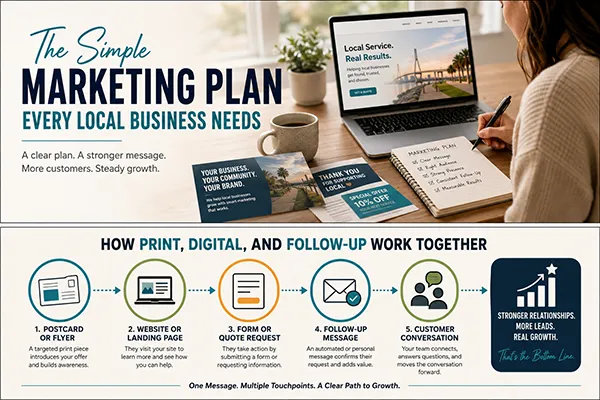
Marketing becomes much easier to manage when each piece supports the next instead of standing alone. Here is a simple example of how a connected campaign could work for a local business in the Charleston area:
A postcard introduces a seasonal offer and names a clear problem your customers care about.
The postcard sends people to a clear landing page or section of your website with a simple web address or QR code.
The website explains the offer in more detail, repeats your main message, and highlights reviews or trust signals.
A short form captures the lead with your main call to action, such as “Schedule an Appointment” or “Get a Quote.”
A follow-up message confirms their request, sets expectations, and lets them know when they will hear from your team.
Your team is notified so they can respond quickly, answer questions, and guide the customer to the next step.
Later, you can invite happy customers to leave a review or join a customer retention campaign, supported by email, print pieces, or promo products.
This kind of connected flow is what turns scattered activity into a simple, repeatable local business marketing plan. BLDC’s marketing strategy and campaign planning services are built to help you design these paths in a way that fits your team and your goals.
Common Marketing Mistakes Local Businesses Make
If your marketing feels scattered, you are not alone. Here are a few common mistakes we see local businesses make—and that you can avoid:
Trying to market to everyone instead of a specific, local audience.
Changing the message too often, so customers never hear the same story twice.
Using vague calls to action that do not clearly invite a next step.
Sending people to a confusing website that does not match your print or ads.
Ordering print materials without a campaign goal or clear offer in mind.
Ignoring reviews and online reputation, even though they shape first impressions.
Failing to follow up quickly when someone shows interest or fills out a form.
Measuring activity—posts, emails, flyers—instead of real next steps like calls, appointments, and quotes.
Avoiding these mistakes does not require a complicated system. It simply requires a clear message, a focused plan, and a guide who can help you connect your digital and print marketing into one simple path.
A Simple 3-Step Plan to Get Started
Book a Marketing Strategy Session. In this conversation, we will talk through your goals, audience, message, and current marketing. You bring what you are already doing; BLDC listens, asks questions, and helps you see the bigger picture.
Build a Clear Campaign Plan. Together, we will connect the right mix of website, online presence, print, direct mail, promotional products, and follow-up. This is where services like custom websites, BOOST, smartPRINT, branded print portals, and lead follow-up come together in a way that fits your business.
Launch With Confidence. With a simple local business marketing plan in place, you will have a clearer message, stronger materials, and a more organized path for customers to take action. Your team will know what to say, where to say it, and how to follow up.
Ready to Make Your Marketing Easier to Manage?
You work hard to serve your customers. Your marketing should support that work, not add to the stress. If your website, print, digital presence, and follow-up feel scattered, you do not have to keep guessing what to do next. A simple marketing plan for local business can help you share a clearer message, build stronger customer trust, and create an easier path for people to take the next step with you.
As a family-owned Charleston and Mount Pleasant marketing agency, Bottom Line Digital Communications is here to guide you, not replace you. You are the hero of your business story. We simply help you connect the pieces—marketing strategy, clear, lead-focused website design, BOOST for stronger online presence, print and direct mail, smartPRINT and branded print portals, promo products, and marketing follow-up—into one straightforward growth system that fits your goals.
Book a Marketing Strategy Session with Bottom Line Digital, and take the first step toward a simpler, more connected marketing plan that works for your local business and your customers.
